One hospital floor. Five consultants. One plaster room that has seen 15 years of healing. This is the story of the people who get Delhi walking, running and playing again.

Most people meet an orthopedic surgeon once: in a consultation room, holding an X-ray, worried about a knee that won’t straighten or a shoulder that keeps slipping out. What they rarely see is everything happening around that one meeting. The resident who checked the wound at 7 a.m. The technician whose plaster decides whether a fracture heals straight. The coordinator who found a slot on a fully booked day.
In this video tour, Dr Rajeev Verma, Chairman of the Manipal Institute of Bone & Joints at Manipal Hospital Dwarka, New Delhi, walks you through his department and introduces the team behind every surgery. Watch it first, then read on. Each “episode” below goes deeper into one member of the team, what they do, and when you might need them.
Prologue
Why one surgeon is never enough
Orthopedics today is too wide for any one person to master every corner of it. A torn ACL in a 24-year-old footballer, a shattered ankle after a road accident, a worn-out knee in a 68-year-old grandmother and a failed hip implant from fifteen years ago are four completely different problems. Each one calls for a different set of skills, instruments and recovery plans.
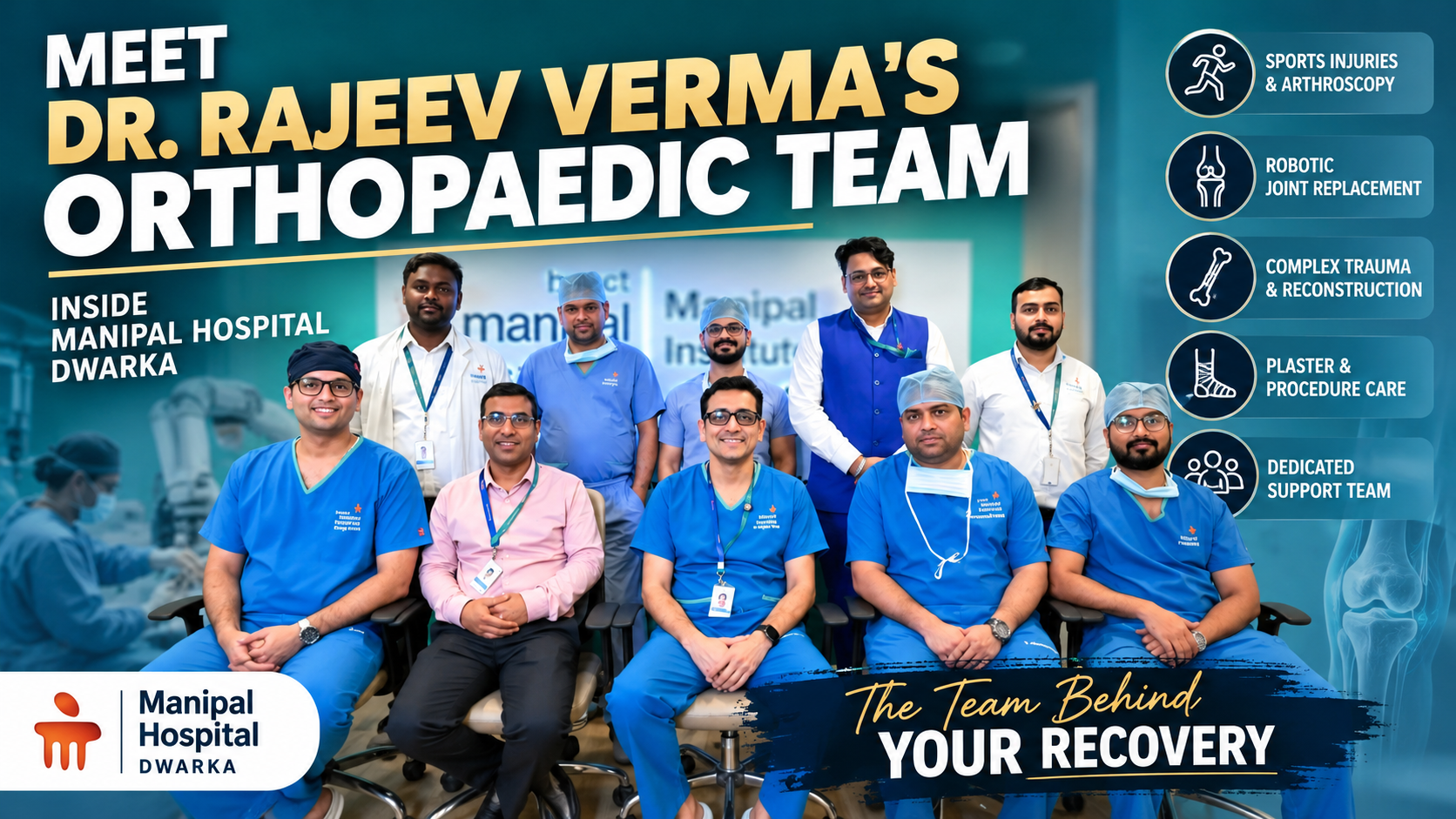
That is why the department Dr Verma leads is built like an ensemble cast. In his own words from the video, the department has five consultants, supported by four senior residents in orthopedics, with plaster technicians, coordinators and a physiotherapy team working alongside them. Each consultant has a sub-specialty focus, so your case goes to the person who handles it most often.
- Where
- Manipal Institute of Bone & Joints, Manipal Hospital, Sector 6, Dwarka, New Delhi 110075
- Led by
- Dr Rajeev Verma, Chairman
- Consultants
- Five orthopedic surgeons with sub-specialty focus
- Residents
- Four senior residents in orthopedics
- Support
- Plaster technicians, nursing staff, coordinators, physiotherapy team
- Covers
- Robotic knee and hip replacement, revision surgery, sports injuries, arthroscopy, complex trauma, foot and ankle, deformity correction, limb reconstruction
Episode 1
The showrunner: Dr Rajeev Verma
He doesn’t just operate. He built the room everyone else operates in.

Every good series has someone who holds the whole story together. Here, that is Dr Rajeev Verma, Chairman of the Manipal Institute of Bone & Joints. With over 25 years of experience and more than 10,000 joint replacement surgeries, he is known in Delhi for robotic knee replacement, hip replacement, sports injury care and arthroscopy, with a strong focus on minimally invasive and robotic-assisted techniques that aim for faster recovery.
What the video shows, though, is the part that doesn’t appear in a biography: the way he walks through each room, introduces each person by name, and describes their role with real pride. A department where the chairman knows the plaster technician’s years of experience off by heart is a department where details are not left to chance.
When you would see Dr Verma
Knee arthritis that no longer responds to medicines or physiotherapy, hip pain from arthritis or avascular necrosis (AVN), complex sports injuries, shoulder problems, osteoporosis, or a second opinion on whether you really need surgery.
Explore his signature programmes: KneeStrong knee replacement and HipStrong hip replacement.
Episode 2
The athlete’s ally: Dr Lalit Bafna
For the runner who heard a pop, and the cricketer whose shoulder won’t stay in place.

Dr Verma introduces him as the team’s sports injury specialist, the one who handles complex sports injuries, especially of the upper limb. Dr Lalit Bafna completed his orthopedics training at Delhi University, worked as a senior resident at AIIMS, New Delhi, and then specialised in sports medicine and arthroscopy (keyhole joint surgery).
At Manipal Hospital Dwarka, he routinely performs knee and shoulder arthroscopy, including:
- ACL and PCL reconstruction for torn knee ligaments
- Meniscus surgery for torn knee cartilage cushions
- Surgery for recurrent shoulder dislocation (a shoulder that keeps “coming out”)
- Rotator cuff repair for torn shoulder tendons
- Other sports medicine problems of the knee and shoulder
Why timing matters in sports injuries
A torn ACL does not heal on its own the way a bruise does. The American Academy of Orthopaedic Surgeons (AAOS) explains that treatment depends on the person’s age, activity level and how unstable the knee feels, and that rehabilitation matters whether or not surgery is done (AAOS OrthoInfo). The AAOS clinical practice guideline on ACL injuries recommends, with moderate evidence, that reconstruction be done within about five months of injury when surgery is needed, to protect the rest of the knee (summary of the AAOS guideline).
Shoulders tell a similar story. In people over 40, a shoulder that dislocates repeatedly often hides a rotator cuff tear as well. One study found cuff tears in about 81% of older patients with recurrent dislocation, far more than in younger patients (Rev Esp Cir Ortop Traumatol). This is exactly why a shoulder-focused sports surgeon makes a difference: the problem you can feel is not always the only problem inside.
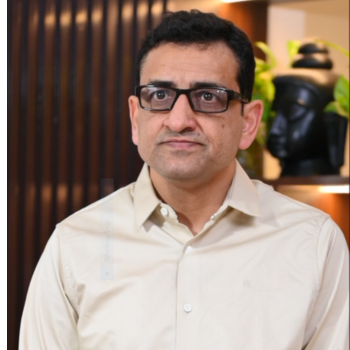
Dr Lalit Bafna, in the video
Read more: how shoulder injury and dislocation are treated · runner’s knee explained · tennis elbow treatment
Send us your symptoms or MRI on WhatsApp and the sports injury team will guide your next step.
WhatsApp the sports injury teamEpisode 3
Behind the plaster room door: Mr Ajit Ray and the nursing team
No one films this room. It’s where half the healing actually happens.

The camera then follows Dr Verma into a room most hospital videos skip: the plaster room, which doubles as the department’s procedure room. This is where casts are applied, stitches are removed and wounds are dressed.
It belongs to Mr Ajit Ray, the plaster technician, with around 15 years of experience. Dr Verma calls him one of the best in the job. That praise matters more than it sounds. A cast that is too tight can cause swelling and pain; one that is too loose can let a fracture shift. A dressing done carelessly can invite infection after an otherwise perfect surgery. Getting these small things right, every single day, is what turns a good operation into a good outcome.

Next door is the room where nurses check blood pressure and record every patient’s vital signs. It is a quiet but important checkpoint: blood pressure, sugar and heart health all affect when surgery is safe and how anaesthesia is planned.
Episode 4
The reconstructor: Dr Lalit Lohiya
Broken in many places. Rebuilt in one.

Dr Verma introduces Dr Lalit Lohiya as one of his key team members. He is a senior consultant who focuses on complex trauma, foot and ankle surgery and joint replacement.
He completed his MBBS at Maulana Azad Medical College, New Delhi, and his Master of Surgery (MS) at Lady Hardinge Medical College. Over more than 15 years, he has performed more than 15,000 procedures across:
- Joint replacement
- Complex trauma surgery, such as multiple fractures and fractures into the joint
- Deformity correction, straightening bones that healed crooked or grew unevenly
- Limb reconstruction, rebuilding limbs after severe injury, infection or bone loss
Why foot and ankle care deserves a specialist
The ankle carries several times your body weight with every step. A fracture that heals even slightly out of line can lead to early arthritis years later. Accurate fixation the first time, by someone who handles these injuries routinely, is the best protection against that.
Episode 5
The precision engineer: Dr Bharat Bhushan Chauhan
Where a surgeon’s experience meets a robot’s millimetre accuracy.

Described by Dr Verma as an integral part of the team, Dr Bharat Bhushan Chauhan works as a consultant in orthopedics and joint replacement at Manipal Hospital Dwarka, where he has served for eight and a half years. He has around 12 years of post-postgraduate experience and completed his postgraduation at Rabindranath Tagore (RNT) Government Medical College, Udaipur.
His work covers complex trauma and joint replacement, including primary and revision replacement of both the hip and knee. A revision is a second operation to replace an implant that has worn out, loosened or become painful, and it is often harder than the first surgery because of bone loss and scar tissue.
The robot in the room
The department uses a state-of-the-art surgical robot, routinely, for both primary and revision knee replacement. The surgeon stays in charge throughout; the robot helps plan and guide bone cuts so the implant sits exactly where it was planned.
What does the research say? A systematic review and meta-analysis in Knee Surgery, Sports Traumatology, Arthroscopy found that robotic-arm assisted knee replacement achieved better accuracy in implant positioning and better patient-reported outcomes than manual surgery in short-to-mid-term follow-up (PubMed). Another meta-analysis found active robotic systems improved mechanical alignment, while noting that long-term benefits still need more study (PMC). In plain words: robots help with precision, and precision in experienced hands is what you want.
See how it works: knee replacement explained · knee replacement FAQs · pain and recovery after knee replacement
Share your X-rays and the team will tell you honestly whether you need surgery now, later, or not at all.
Ask about robotic knee replacementEpisode 6
The next generation: Dr Rajat Srivastava and the senior residents
The first face you see on the ward, and often the last one before you go home.

Behind the consultants is a group of four senior residents in orthopedics, qualified orthopedic doctors gaining advanced experience under the consultants. Dr Verma introduces one of them, Dr Rajat Srivastava, as one of the department’s junior surgeons.
Residents assist in surgery, check on patients after operations, review wounds and pain levels, and pass on any concern to the consultant straight away. For a patient, this means there is always an orthopedic doctor close by, not just during the consultant’s visit.
Episode 7
The people who keep the show running: the coordinators
Every great production has a crew you never see on the poster.

The tour ends where most patients’ journeys begin: the front desk. Two coordinators, Mr Bittu and Mr Deepak, look after all appointments and everything around the department. They schedule consultations, line up tests, and help families understand what happens next.
Alongside them, the physiotherapy team takes over once surgery is done. Recovery after a joint replacement or ligament reconstruction depends heavily on the right exercises at the right time, and having physiotherapists inside the same team keeps everyone working from one plan.
Finale
Your journey through the team, step by step
Put the episodes together and here is what a typical patient journey looks like:
- Reach out. Message on WhatsApp or call. The coordinators book your consultation and tell you what reports to bring.
- Check-in and vitals. Nurses record your blood pressure and vital signs.
- Consultation with the right specialist. Joint replacement, sports injury, trauma or foot and ankle, matched to your problem.
- A clear plan. Tests if needed, then an honest discussion of non-surgical and surgical options.
- Treatment. Surgery, robotic or conventional, arthroscopy, or a cast and physiotherapy alone.
- Plaster, dressings and stitch removal. Handled in the procedure room by an experienced technician.
- Rehabilitation and follow-up. Physiotherapy and review visits until you are back to your routine.
Your story can start with one message
Book a consultation with Dr Rajeev Verma and the orthopedic team at Manipal Hospital Dwarka, or at the Gurugram wellness clinic.
Delhi: Manipal Hospital, Sector 6, adjoining MTNL building, Main Road, Dwarka, New Delhi 110075
Gurugram: Wellness clinic, C 315, Nirvana Courtyard, Nirvana Country, Gurugram
Email: orthosurgeondrrajeevverma@gmail.com
Watch more: YouTube · Instagram
Questions patients ask
Who leads the orthopedic team at Manipal Hospital Dwarka?
The Manipal Institute of Bone & Joints is led by Dr Rajeev Verma, its Chairman, who has over 25 years of experience and more than 10,000 joint replacement surgeries.
Is robotic knee replacement available at Manipal Hospital Dwarka?
Yes. The team uses a state-of-the-art surgical robot routinely for both primary and revision knee replacement. Whether it suits you depends on your knee, your bone quality and your overall health, which the surgeon assesses at consultation.
Who treats sports injuries like ACL tears and shoulder dislocation?
Dr Lalit Bafna, the team’s sports medicine and arthroscopy specialist, treats ACL and PCL tears, meniscus injuries, recurrent shoulder dislocation and rotator cuff tears, working with Dr Verma.
Does the team handle complex fractures and foot and ankle problems?
Yes. Dr Lalit Lohiya focuses on complex trauma, foot and ankle surgery, deformity correction and limb reconstruction, and Dr Bharat Bhushan Chauhan also manages complex trauma cases.
What is revision joint replacement?
It is a second surgery to replace a hip or knee implant that has worn out, loosened, become infected or painful. The team performs revision hip and knee surgery.
How do I book an appointment?
Message on WhatsApp at +91 821 082 2515 or call the same number. The coordinators will arrange your visit at Manipal Hospital Dwarka, New Delhi, or the Gurugram clinic.
References and further reading
- American Academy of Orthopaedic Surgeons. ACL Injury: Does It Require Surgery? OrthoInfo.
- American Academy of Orthopaedic Surgeons. Management of Anterior Cruciate Ligament Injuries: Clinical Practice Guideline.
- MDedge. AAOS Guidelines Sum-Up Prevention and Treatment Strategies for ACL Injuries.
- MedlinePlus, U.S. National Library of Medicine. Anterior cruciate ligament (ACL) injury.
- Knee Surg Sports Traumatol Arthrosc. 2022;30(8):2677–2695. Robotic-arm assisted total knee arthroplasty is associated with improved accuracy and patient reported outcomes: a systematic review and meta-analysis.
- Efficacy and reliability of active robotic-assisted total knee arthroplasty compared with conventional total knee arthroplasty: a systematic review and meta-analysis. PubMed Central.
- Revista Española de Cirugía Ortopédica y Traumatología. Glenohumeral instability in patients over 40 years of age.
This page is for general information and does not replace a medical consultation. Treatment decisions depend on individual examination and investigations.