Delhi: Manipal Hospital,Sector 6 adjoining MTNL building, Main Rd, Dwarka, New Delhi, Delhi 110075
Gurugram: Wellness clinic, C 315, Nirvana courtyard, Nirvana country, Gurugram


If you've noticed that your knees have started to look crooked — bowing outward like a cowboy's stance, or drifting inward like a knock-kneed posture — you're not imagining things. And it isn't just wear and tear. Your own body is doing this on purpose. The problem is, the "solution" is slowly making things much worse.
According to orthopaedic specialist Dr Rajeev Verma - Chairman at Manipal Institute of Bone & Joint Surgery, Manipal Hospital Dwarka, Delhi, this kind of visible knee deformity is one of the clearest signs that osteoarthritis has progressed to a severe stage — and that the joint may require medical intervention soon. Understanding why it happens is the first step toward stopping it.

Not all knee deformities look the same. Doctors classify them into two distinct patterns, each with a different appearance and a slightly different cause.
Varus Deformity (Bow-Legged) The gap between the inner surfaces of the knee joint widens as cartilage erodes. This pushes the knees outward, creating a characteristic bow-legged appearance. It is the most common deformity seen in osteoarthritis of the knees.
Valgus Deformity (Knock-Kneed) In this pattern, the knee shifts inward while the ankle and foot swing outward. From the front, the legs form an "X" shape. Doctors describe this as a sign of severe degenerative or deforming arthritis — and a clear signal that intervention may be needed.
Both of these are considered by orthopaedic experts to be signs of severe deformity and severe arthritis. They are not cosmetic issues. They are clinical red flags.
"This is a sign of severe deformity and severe arthritis — one that may need intervention." — Delhi Manipal Hospital Orthopedic & Joint replacement department Chairman Dr Rajeev Verma, on Valgus & Varus Knee Deformity
To understand knee deformity, you need to understand one anatomical concept: the weight-bearing line.
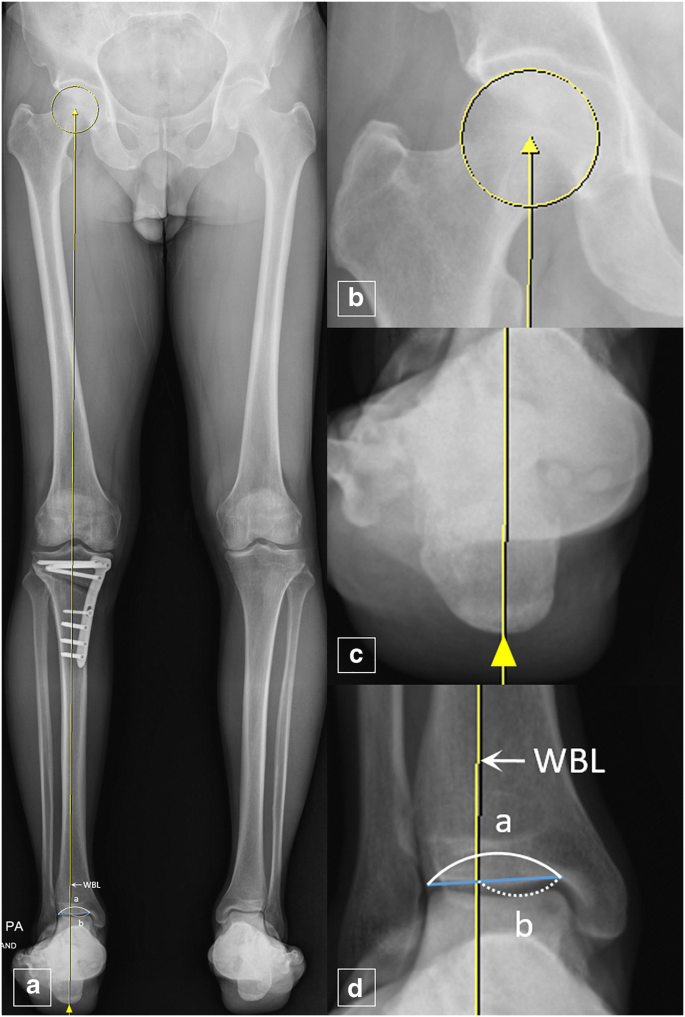
When you stand or walk, your body weight travels down a straight line from your hip to the ground. In a healthy knee, this line passes through the centre of the knee joint — distributing pressure evenly across the cartilage.
But here's the catch: that weight-bearing line naturally passes slightly toward the inner (medial) side of the knee. This means the inner compartment of your knee joint bears slightly more load than the outer compartment, day after day, year after year.
As a result, when degeneration begins — whether from aging, excess weight, or repeated strain — it almost always starts on the inner part of the knee first. The cartilage on the inside erodes first. The bone underneath becomes exposed. And then the pain begins.
This is where biology does something fascinating — and ultimately problematic. When the inner compartment of the knee becomes painful, your body instinctively tries to take the load off that area. It does this by shifting the joint into a position where the damaged part carries less weight.
Here is how that process unfolds, step by step:
Step 1 — Pain Triggers Compensation The inner knee becomes painful due to eroded cartilage and bone-on-bone contact. The brain registers this as a threat and signals the body to adjust its posture.
Step 2 — The Knee Flexes and Rotates Outward To offload the painful inner compartment, the knee automatically bends slightly (flexion) and rotates outward. This shifts the weight-bearing line away from the damage zone.
Step 3 — The Deformity Becomes Permanent Over time, the muscles, ligaments, and tendons around the knee adapt to this new position. The joint locks into the compensated posture — and the visible deformity is the result.
⚠️ Important to understand: The deformity is not the cause of the problem — it is a consequence of it. Your body is trying to protect the damaged area, but in doing so, it places more load on other structures and accelerates degeneration elsewhere. Ignoring a visible knee deformity is never safe.
Dr Rajeev Verma point to a simple analogy that makes this body mechanism instantly clear.
Elbow Injury: If you hurt your elbow, you instinctively hold your arm in a bent, guarded position — not because anyone tells you to, but because your body automatically avoids loading the painful area.
Ankle Sprain: After a rolled ankle, you begin walking with a pronounced limp — placing weight on the outer edge of the foot to avoid pressure on the sprained area. You walk "crooked" to stay comfortable.
Arthritic Knee: The same reflex is at work. The knee shifts, bows, or twists to protect the eroded cartilage inside — and if left untreated, this protective posture becomes a permanent structural deformity.