Delhi: Manipal Hospital,Sector 6 adjoining MTNL building, Main Rd, Dwarka, New Delhi, Delhi 110075
Gurugram: Wellness clinic, C 315, Nirvana courtyard, Nirvana country, Gurugram

Medically reviewed by Dr. Rajeev Verma, MRCS (England), MSc Orthopaedics (UK), Chairman, Manipal Institute of Bone & Joints
Robotic knee replacement is a newer way of doing total and partial knee replacement. A CT scan of your knee is used to plan every bone cut and the implant size on a computer, and a robotic arm controlled by the surgeon makes those cuts with millimetre accuracy while a camera tracks the knee in real time. The aim is precise implant placement, often with less blood loss, which is expected to help the new knee last longer.
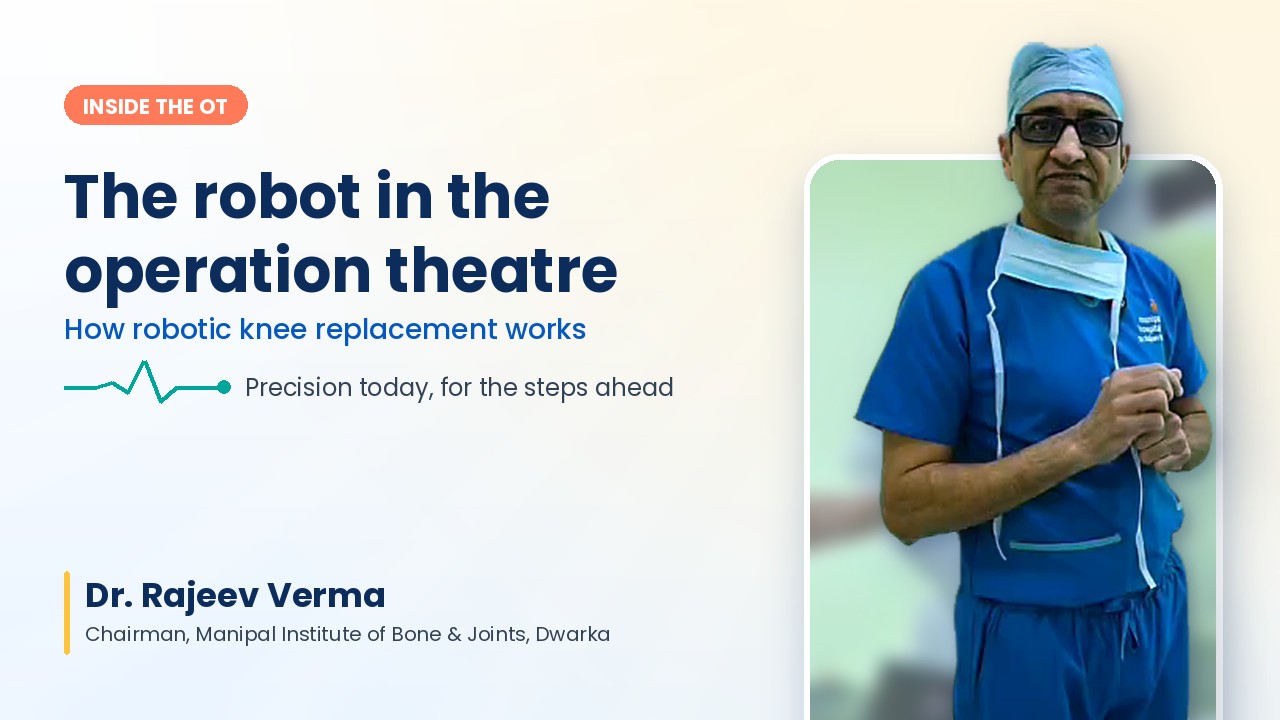
In this short video, recorded inside the operation theatre, Dr. Rajeev Verma, Chairman of the Manipal Institute of Bone & Joints at Manipal Hospital, Dwarka, New Delhi, with more than 25 years of experience and over 10,000 joint replacements, shows the robotic system and explains how it works, step by step.
Dr. Rajeev Verma on robotic knee replacement (Hindi, 1 min 49 sec). Watch on YouTube. Full transcript further down.
Most people put off a knee replacement for years. These are the signs patients usually describe when they finally come in:
If several of these sound familiar, it is worth finding out what stage your knee is at. Not every painful knee needs surgery, and when it does, you deserve to understand the options clearly.
Wondering if robotic knee replacement is right for you? Dr. Rajeev Verma will examine your knee, review your X-rays and explain whether you need surgery, and if so, which kind.
Book a knee assessmentCall +91 82108 22515
Standing beside the robot in the operation theatre, Dr. Verma explains why he now performs total and partial knee replacements with the robotic technique:
"The cuts are planned from the patient's own anatomy so that the angle stays accurate, and every cut is taken with millimetre accuracy. With accurate cuts, the implant is placed very accurately. There is also a theory that if the implant is placed accurately, it will last longer and its wear rate will be lower."
Dr. Rajeev Verma, Chairman, Manipal Institute of Bone & Joints, Manipal Hospital, Dwarka
Here is how a robotic knee replacement works, in the order Dr. Verma describes it in the video:
| Step | What happens | Why it matters |
|---|---|---|
| 1. CT scan | A CT scan of the knee is taken after admission, before the operation | Gives a 3D picture of your own bones, not an average knee |
| 2. Computer plan | The scan is fed into the robot's computer; the surgeon plans how much bone to cut and which implant size to use | The cuts and angles are decided in advance, to the millimetre |
| 3. Trackers and camera | Small trackers on the leg are followed by a camera throughout the operation | Shows the real-time position of the knee on screen |
| 4. Robotic arm | An arm fitted with a burr (or a saw in some systems), guided by the surgeon, removes bone to the plan | Helps avoid cutting too much bone or missing an area |
| 5. Implant placement | The implant is fitted on the precisely prepared bone | Accurate position and alignment of the new knee |
The robot does not operate on its own. The surgeon plans the operation, positions the arm, and stays in control of every cut.

In both methods, the worn surfaces of the knee are replaced with a metal and plastic implant. What changes with the robot is how the operation is planned and how precisely the bone is cut.
Research shows that robotic surgery places the implant closer to the plan, with fewer alignment errors, and many studies report somewhat lower blood loss. It also has trade-offs: the operation can take a little longer, it costs more, and studies proving a longer implant life are still being collected.
| Compare | Robotic-assisted | Conventional (manual) |
|---|---|---|
| Planning | 3D plan from your CT scan | Planned from X-rays and measured during surgery |
| Bone cuts | Robotic arm guided by the surgeon, checked in real time | Cutting guides placed by the surgeon |
| Alignment accuracy | Fewer alignment errors in studies | Very good in experienced hands, with more variation |
| Blood loss | Often somewhat lower | Usually a little higher |
| Operating time | Can be a little longer | Usually a little shorter |
| Long-term implant life | Expected benefit from accurate placement; long-term proof still emerging | Proven over decades |
| Cost | Usually higher | Usually lower |
Whichever technique is used, recovery depends just as much on physiotherapy and getting moving early. Neither method suits every patient, which is why the decision is made after a proper assessment.
Have your X-ray or MRI already? Send it on WhatsApp and the team will help you plan a consultation with Dr. Verma at Manipal Hospital, Dwarka.
Book an appointmentWhatsApp your X-rayBefore suggesting any surgery, every knee is assessed in four steps:
Typical examples, not individual patients.
Dr. Verma performs knee replacement at Manipal Hospital, Sector 6, Dwarka, New Delhi, and also consults at a clinic in Nirvana Country, Gurugram.
It is a knee replacement in which a CT scan of your knee is used to plan the operation on a computer, and a robotic arm guided by the surgeon makes the bone cuts to that plan. It is used for both total and partial knee replacement.
Studies show that robotic surgery places the implant closer to the planned position, with fewer alignment errors than the manual technique. Early recovery and comfort may be slightly better, but both methods give good long-term results in experienced hands.
No. The surgeon performs the operation and stays in control throughout. The robotic arm helps make the planned cuts precisely, and a camera tracks the knee in real time so that cuts are neither too deep nor missed.
The CT scan creates a 3D model of your knee. It is used to plan how much bone to remove, the angle of each cut and the right implant size before the operation begins.
Yes. Robotic technique is used for partial knee replacement as well as total knee replacement. Whether a partial replacement suits you depends on how much of the knee is worn and on the ligaments, which your surgeon checks before deciding.
Many studies report somewhat lower blood loss, because the cuts are precise and the soft tissues are disturbed less. The difference varies from patient to patient, and the operation can take a little longer than the manual method.
Accurate implant placement is expected to reduce wear and help the implant last longer, but long-term studies proving this are still being collected. How long any knee replacement lasts also depends on your weight, activity and general health.
Look for an orthopaedic surgeon who performs both robotic and manual knee replacement and explains why one suits you. Dr. Rajeev Verma is Chairman of the Manipal Institute of Bone & Joints at Manipal Hospital, Dwarka, with more than 25 years of experience and over 10,000 joint replacement surgeries, including robotic-assisted knee replacement.
See an orthopaedic surgeon if knee pain limits walking or stairs, disturbs sleep, or continues despite medicines and physiotherapy, or if your leg is becoming bowed. Seek care urgently if the knee is hot, red and swollen, gives way, or you have a fever.
Dr. Rajeev Verma performs robotic knee replacement at Manipal Hospital, Sector 6, Dwarka, New Delhi, and also consults at a clinic in Nirvana Country, Gurugram. For appointments, call or WhatsApp +91 82108 22515.
Recorded by Dr. Rajeev Verma at Manipal Hospital, Dwarka, November 2026. Duration 1 minute 49 seconds.
The latest technique with which we do joint replacement in patients, especially total knee replacement and partial knee replacement, is the robotic technique. It has quite a lot of advantages over the manual technique. First, there is less blood loss. Second, the cuts are planned from the patient's anatomy so that the angle stays accurate. Along with that, the cuts are minimal; every cut is taken with millimetre accuracy.
Today we admitted a patient. We do a CT scan and plan how much bone needs to be cut and what size of implant will be used, and it tells us all of this accurately. We feed the CT scan into the computer. We save it on a small disk that goes into the USB port here.
What you are seeing here is the robotic arm. A burr fits on its front, or in some robotic arms a saw, which takes the accurate cut. This is the camera. The trackers we place on the patient are captured by this camera, so that it keeps telling us the real-time anatomy accurately: whether a cut is going extra somewhere, or whether a cut is being missed somewhere. We keep watching this on the screen.
Basically, the burr arm, the robotic arm, stays on the side being operated: if it is the right side, it stays on the right. This one stays on the opposite side, so that we as surgeons can see. One more advantage is that the robotic arm stays in our control, so we do not let the patient's anatomy be disturbed. With accurate cuts, the implant is placed very accurately. There is also a theory that if the implant is placed accurately, it will last longer, and its wear rate will be lower.
जो latest technique है जिससे हम patients में joint replacement करते हैं, especially total knee replacement और partial knee replacement, वो हम आजकल robotic technique से करते हैं। काफी ज्यादा advantage है manual technique से। Specially उसमें एक तो blood loss कम होता है। Secondly, जो cuts लिए जाते हैं वो patient के anatomy से plan होते हैं ताकि उसका angle accurate रहे। साथ में उसका cut भी minimum जैसे it is सब millimeter accuracy से cut लिए जाते हैं।
आज हमने patient admit किया। उसका हम CT scan करते हैं और planning करते हैं कि उनमें कितना cut लेना है, implant किस size का लगेगा तो वो पूरा accurate हमें बता देता है। CT scan को computer में feed करते हैं। उसको हम save करते हैं एक छोटी disk पे जो कि यहां लगती है USB port में।
तो ये देख रहे हैं आप robotic की arm है जिसमें आगे burr लगता है या कुछ robotic arm में saw भी लगती है जिससे accurate cut लिया जाता है। ये camera है जो हम patient पे जो tracker लगाते हैं वो ये camera में capture होते हैं तो ताकि बिल्कुल accurate बताता रहे हमें real time anatomy कि cut कहीं extra तो नहीं हो रहे या कहीं पे cut कहीं miss तो नहीं हो रहा और ये screen पे हम देखते रहते हैं।
तो basically जो ये burr वाली arm है या robotic arm है वो patient जिस side का operation अगर right side का है तो right side रहेगी। ये opposite रहेगी opposite side पे ताकि हम as a surgeon देख सकें। एक और advantage है ये robotic arm हमारे control में रहे तो ये patients की anatomy और उसको हम disturb नहीं होने देते। Accurate cuts लेके बिल्कुल accurate placement implant होती है। उसका ये भी theory है कि अगर accurate placement of implant होगी तो वो implant ज्यादा देर चलेगा। उसमें wear rate कम होगा।
Living with knee pain doesn't have to be the plan for the rest of your life. One consultation tells you where your knee stands today, whether you need surgery at all, and what a robotic knee replacement would mean for you.
Book a knee assessmentCall +91 82108 22515WhatsApp your X-rayWhere to consult: Manipal Hospital, Sector 6, adjoining MTNL building, Dwarka, New Delhi 110075; Wellness Clinic, C-315, Nirvana Courtyard, Nirvana Country, Gurugram.
Dr. Rajeev Verma, MRCS (England), MSc Orthopaedics (UK), is Chairman of the Manipal Institute of Bone & Joints at Manipal Hospital, Dwarka, New Delhi. He has more than 25 years of experience and has performed over 10,000 joint replacement surgeries. He performs primary and revision knee and hip replacement using minimally invasive, computer-navigated and robotic-assisted techniques. Visit his website.
Related reading: Total knee replacement in Delhi, KneeStrong knee replacement, Knee replacement FAQs, Pain and recovery after knee replacement